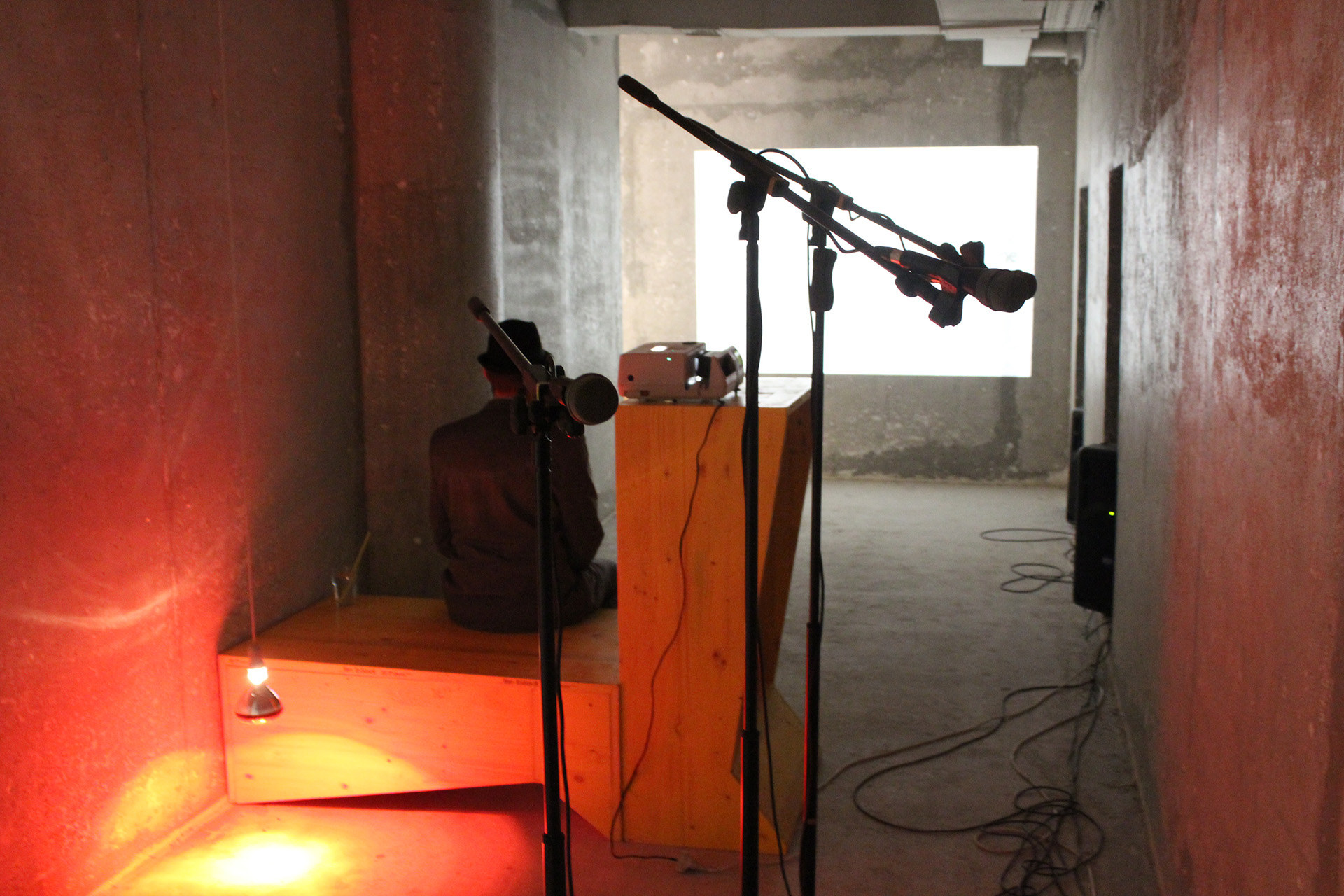
For about a month now, Split's cultural circles and social cliques have been whispering about sub-zero temperatures, even though the snow crisis is a chapter long behind us. The story leads us to a newly opened club and gallery space, set in an old nuclear shelter on level minus 3, right next to Prima 3, an important urban landmark of new Split. And it is truly strange, and a little conspiratorial, to find yourself there, since every descent underground carries rituals of hiding, or of some heterotopic displacement. Once you are on the open expanse of the Prima 3 car park, you will see a concrete opening with a door. And as if by some trick, or by the narrative logic of Lewis Carroll, you find yourself several floors below, where a whole new world opens up, one that for about a month has been gathering and absorbing a different constituency of the city... Behind the Minus 3 club stands, above all, the collective initiative of a few individuals, including the artist Viktor Popović and the theorist and curator Blaženka Perica. For the first exhibition and the gallery presentation of the space, Blaženka Perica chose the figure and work of Dragana Sapanjoš, whose exhibition project closed recently with a finissage held precisely on International Women's Day.
The Croatian public certainly knows Dragana Sapanjoš from the work presented at the final exhibition of the Radoslav Putar Award in 2010, when, with a provocative installation of a squad of live cockroaches under glasses on the gallery floor, she suggested what we might call an aesthetics of ugliness, building a living, but also very morbid and fragile, artistic installation or situation. Looking at that gesture through the mechanisms of parable, broader questions arise about the relationship with the viewer, about rethinking what relational aesthetics might be, and about the frameworks of exhibiting art today. Not without a grain of cruelty and irony, but also of courage and sincerity. This artist from Novigrad, with a Milan address, recently surprised the public with her demanding 24-hour performative project Sinking, staged last summer in Novigrad, and these days she has also been written about on the occasion of the prestigious Italian prize for younger artists, the Moroso Art Award, which she received and which will enable her to produce new works and to present them in important international exhibitions.
So what did Dragana Sapanjoš stage in Split, and how did she stir up the walls of a self-proclaimed cultural shelter? As some texts put it, Dragana Sapanjoš lives in her own world of absurdity and enchantment, and with every work she wants to give us a fragment of that reality, so that we might forget our everyday misery, at least for a moment. She staged her fragment of the absurd in the spaces of Minus 3 under the title John Doe, using a sculptural, performative and musical language to fill the entire space with living sculptures. Or, in the words of the curator Blaženka Perica, she created contemporary versions of tableaux vivants.
And here my own experiment begins, prompted by the very form of Dragana Sapanjoš's work. This text will also introduce you to the short critical accounts of five people who were there and who recounted the whole situation to me. I am now passing on their words. They are, in order, the art history students at the Faculty of Humanities and Social Sciences in Split Lana Beović, Anita Dinielli, Antonija Mihovilović and Anita Zelić, and among them a professor, Ivana Čapeta Rakić, who, alongside her research on the Baroque and the Renaissance, is always glad to step into the world of contemporary art practices. All of this takes place within the extracurricular programme Kolosijek H6. In a way, they are also co-authors of this text, as the voices of the audience, about whom we always know so little, even though the exhibition is always there for them too, as a dialogic process, an event, a situation, a field of communication...
We begin with the introduction by Ivana Čapeta Rakić and some of the questions it raises:
"At the entrance we were greeted by a hostess dressed in a white shirt, who directed us with a welcoming gesture towards the back of the Minus 3 space, noting that we were entering at our own risk. The first image, or scene, introduces a karaoke performance: two performers repeat the lyrics of the song Tainted Love, which are projected onto the concrete wall. Throughout the performance the same song repeats, and there is no other source of sound or music in the space. The next day, in the accompanying talk, the artist stressed how important this repetitiveness of sound is. The song here is a kind of mantra, and repetition underlines the need to be displaced into some other psychological dimension. The second scene, tied to the second space, introduces paper forms scattered on the floor, which are hard to read because the performers keep throwing themselves into the viewer's arms (young people, probably students from UMAS, who took part in the project). There is no verbal communication, only silent embraces and 'cuddling', which provokes anything from 'disturbance' or noise to unease... you cannot manage to see the 'paper exhibits' because someone is always in your arms. In the third space there is a beautiful girl with long loose hair and glasses, dressed in a beige trench coat. She kneels, motionless, in the act of tying her sneaker. She is in complete darkness, and the only source of light is a hand torch held by an older gentleman leaning with his back against the opposite wall. He watches her. Leaving that part, I go into the club and sit on the wooden benches arranged around the club (they are not part of the performance). The whole time, a girl in a gold outfit, a tight jumpsuit, with a black motorcycle helmet on her head, moves through the club and the exhibition space on roller skates. In her hand she carries a tray with two glasses. Is she a waitress? She stops beside a viewer, lifts her visor and says: 'This could be dangerous.'"
To this description, into which I also include parts of Anita Dinielli's account, the following comments are added. A few notes: the scenes are thematically unconnected and absurd; they provoke insecurity, perhaps even fear, discomfort. The viewer is unknowingly included in the performance itself, although at first glance it does not look that way. The element of surprise plays a large role, making the viewer feel exposed, but also involved in the event.
Antonija Mihovilović and Lana Beović: "John Doe is an exhibition made up of four unusual scenes in which the visitors themselves take part. That is why it could be called a happening rather than a performance. With audio-visual effects, the artist created a surreal atmosphere, to which the exhibition space of the Minus 3 club certainly contributed, as it is not a conventional, sterile exhibition space. I could even say it was a little claustrophobic, because visitors are forced to take part in the performance constantly, whether they want to or not. Passing through the three main rooms, we did not leave the exhibition space, because the waitress keeps circling around the visitors and stopping by them from time to time."
Anita Zelić: "An unexpected and somewhat strange performance, perfectly fitted into the underground space. A feeling of unease and shock because of the hugging, and a dose of claustrophobia because of the space itself, several metres underground. (I don't think Minus 3 will be seeing me again :)"
The artist herself does not take part in the performance. She is present in the situation, but at a distance, the way directors are. What interests her is following, from the outside, the sequence of transformations, and how the image of the space and of the exhibition changes with the arrival of new viewers and participants, with all their parameters. And what the experience itself suggests, on the level of the viewers, but also of those on the other side, so closely connected, without barriers or accompanying captions. Only living experience. In conversation, speaking about her artistic strategies, Dragana Sapanjoš said that in these situations she is interested only in what she sees: the images she sees, which change individually depending on the reaction of each person. Given the voices the finissage has opened, there is certainly an echo. More precisely, given the situation it provoked, it is hard to imagine there will be no reactions.
Rancière's The Emancipated Spectator speaks of the paradox of the spectator who, facing art, stands opposite it, knowing neither its process of production nor the reality behind it. To look is therefore the opposite of knowing, and of acting. To be a spectator means to be separated at once from the capacity to know and from the possibility of acting. But to what extent does an exhibition like this one cancel that distance, transforming the spectator into an active participant and releasing them from the position of passive observer?
For Rancière, the emancipation of the spectator begins when we decide to question the opposition between looking and acting, when we understand that the self-evident facts that structure the relations between what is said, seen and done belong themselves to the structure of domination and subjection. It begins when we see that looking is also an action that confirms or transforms the distribution of positions. The spectator is also active. They observe, select, compare and interpret. They see, feel and understand their own "poem" as long as they actively compose it together with the poem unfolding before them. Just like John Doe, the unknown face on a wanted poster, an exhibition construct hiding in each of us.
A few questions for Dragana Sapanjoš, in conversation with the artist and by e-mail (9 March 2012)
Ivana Čapeta Rakić: Where does the need to film your works come from? Is it a kind of documentation, or something else?
Dragana Sapanjoš: I need documentation as such. It is a trace, but I am aware that it will not capture what my work truly is, nor all the angles of looking: the performer's, the viewer's, mine. The camera becomes something else. Documentation would be true if I managed to document the viewer's emotions.
IČR: Since in your performative work you are also interested in the direct reaction of the viewers (the audience), how do you get feedback? Do you talk with the participants, or are you exclusively an observer of their reactions?
DS: I think that just as you can feel fear, happiness, unease or tension in a room, you can also feel feedback. I observe.
IČR: Your works come across as highly produced projects. How do you finance your projects, and how much of it is done on a voluntary basis?
DS: Fortunately, everything is voluntary, and I get much more from the people who enter my work than from the performance itself. I get collaboration and sincerity, and I give them everything of myself. I let them take as much as they can take... Giving and receiving, without limits, slowly guiding a fellow player to a certain point, which at the same time exhausts and fills.
IČR: Since your works are known for usually involving many participants while excluding you, I'd like to know who these participants are. How do you get their consent? For example, it is known that you collaborated with the band Let 3, and you involved the police and coroners in one of your works.* How do these professions react to your artwork?
DS: I believe very strongly in what I do, so that enthusiasm can probably be felt on the other side too. They mostly react positively, but even when that is not the case, I turn the situation around and, with the given obstacles, try to carve the work out anew. As for Let 3, that was a collaboration agreed in advance. I proposed the project to them, they accepted it, and then we shaped it together. It was a wonderful experience.**
* The second part of the trilogy Vis Major: Bad Romance (Makina Gallery, Pula). The performance took place at the opening on 11 August 2011; the exhibition ran until 4 September 2011.
** The third part of the trilogy, Vis Major: Alejandro (in collaboration with Let 3, Galerija Šikuti, Savičenta). The performance took place at the opening on 29 October 2011.
Broadcast on 27 March 2012. Translated from the Croatian.